

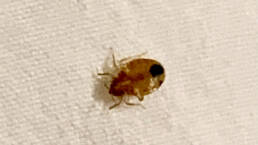
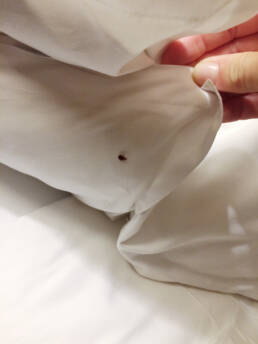
Find a few dark specks on your sheets and the mind goes straight to the worst case. Most calls Hot Bugz takes from worried Denver homeowners start with a photo text and the same question: is this what I think it is? Sometimes it is. Often it is not. The point here is to give you a way to answer that question yourself in about thirty seconds, and to know when the answer needs a professional.
Bed bug fecal stains, mold, and coffee grounds can all look superficially similar. Telling them apart comes down to where you found the stain, what it does when wet, and how it behaves on fabric.
What Bed Bug Stains Actually Look Like
Bed bug feces is digested human blood. That single fact tells you most of what you need to know. The stains appear dark, somewhere between deep brown and near-black, and they bleed into fabric the way ink bleeds. On a white sheet, a fitted sheet seam, or a pillowcase, you will see dots roughly the size of a poppy seed or a fine ballpoint pen mark. They cluster. A single isolated dot is rarely bed bugs. A row of them along the piping of a mattress, the underside of a headboard, or the joint between a box spring and frame is a different story. The dots tend to gather along the side of the bed where the person rests, not the empty side.
The Hot Bugz Wet Swab Test
The fastest way to confirm what you are looking at is the wet swab test. Take a plain white cotton ball, paper towel, or Q-tip and dampen it with water. Press it lightly against the suspicious dot for a second or two. If it is a bed bug fecal stain, the spot will smear into a reddish-brown or rusty streak as the dried blood rehydrates. The pigment is iron-based, the same as a small bloodstain. It dissolves and spreads when wet.
Coffee grounds will not do this. They are solid plant particles, and a wet swab pushes them around without producing a streak. Mold often smudges gray or green and leaves a fuzzy texture behind. The wet swab is the closest thing to a free home diagnostic for bed bug staining. One caveat: old stains laundered repeatedly can be too set to smear well. If the location and pattern fit and the swab is unclear, do not rule out bed bugs on the swab alone.
What Mold Looks Like Up Close
Mold and bed bug stains live in different parts of the home. Mold follows moisture. It shows up around bathroom ceilings, basement corners, the inside of window frames, behind a leaky toilet, or in the silicone seal of a shower. The pattern is diffuse, growing outward in patches that range across black, green, gray, and chalky white.
Bed bug fecal stains on a wall are pinpoint dots arranged in clusters near where someone sleeps. Mold on a wall is a spreading patch with a fuzzy or velvet-like surface. If a stain has any height when you run a finger across it, it is more likely mold or mildew. Bed bug feces dries flat into the fabric or surface.
The smell test helps. Mold tends to produce a damp, earthy odor. Bed bug stains are essentially odorless on their own.
Coffee Grounds and Other Lookalikes
Coffee grounds are usually easy to rule out by location. They live in kitchens. If a stain is granular, sits on top of a surface rather than soaking in, and brushes away with a hand, it is almost certainly food or organic debris. The same logic covers pepper flakes, soil, and crumbs.
A few other lookalikes worth knowing. Cockroach droppings are larger and pellet-shaped, often with visible ridges. Mouse droppings are bigger still, rice-grain sized and tapered at the ends. Spider droppings tend to be two-toned, with white and dark mixed together. None of those leave the rust-colored streak that bed bug fecal stains produce under a wet swab.
When to Stop Testing and Call a Professional
If your wet swab leaves a rust-colored streak, stop. Do not crush, vacuum, or spray the area. Photograph what you found and check the surrounding seams of the mattress, box spring, and headboard for live bugs, shed skins, or pale eggs the size of a grain of rice. A bed bug stain rarely exists in isolation, and a thorough visual inspection usually turns up the larger picture.
Once you have evidence, treat the rest as a containment problem. A heat treatment from Hot Bugz reaches every crack and seam at lethal temperatures, kills every life stage including eggs, and does it without chemicals or the need to throw out furniture.
Trust the Test, Trust the Location
Most stain identification questions resolve quickly once you combine the wet swab test with where the stain is. Coffee grounds in the kitchen, mold in the bathroom, and rust-colored streaks along a mattress seam tell three different stories. If the streak you find points to bed bugs, get an inspection scheduled before the cluster grows. Hot Bugz handles Denver inspections within the same week in most cases.

Ready for an expert opinion? Get in touch today!
We kill bed bugs in the infested space and surrounding walls by heating the space to a temperature of 135°F, killing all bed bugs and their eggs. If you have a bed bug problem, we have a solution. Exterminate bed bugs today with Hot Bugz. It’s safe and you get to keep your stuff. Call us today for a free consultation.